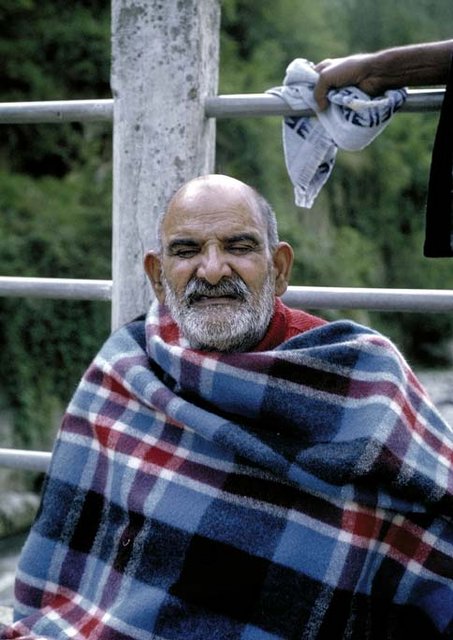
Maharaj-ji
Neem Karoli Baba
A saint of the Kumaon hills who taught almost nothing in the way of doctrine and almost everything in the way of kindness. Wrapped in a plaid blanket, feeding whoever arrived, he pointed everyone back to Hanuman — and to each other.
His life
A life recorded mostly in other people's memories
Maharaj-ji left no autobiography and discouraged biography. What survives is an enormous oral record: thousands of people describing the same qualities — uncanny knowledge of a stranger’s life, indifference to money and status, and an insistence that the visitor eat before they talk. The dates below are the ones most consistently reported.
Early 1900s
Born Lakshmi Narayan Sharma in Akbarpur, Firozabad district, Uttar Pradesh. Exact birth year is uncertain; he never encouraged such record-keeping.
Youth
Married young, then left home to wander as a sadhu, returning years later at his father's request to live as a householder while remaining, in every account, a renunciate at heart.
Neeb Karori village
He stayed near the village of Neeb Karori in Uttar Pradesh, from which the name Neem Karoli Baba came. Devotees simply called him Maharaj-ji.
Temples
Over decades, Hanuman temples and ashrams grew around him across north India — among them Vrindavan, Rishikesh, Shimla, Lucknow and Bhumiadhar.
1964
The ashram at Kainchi Dham was established in the Kumaon hills near Nainital, with the Hanuman temple at its heart. Its annual bhandara is held on 15 June.
1967 onwards
Western seekers began arriving. Richard Alpert became Ram Dass and later wrote Be Here Now, which carried Maharaj-ji's presence to millions who never met him.
11 September 1973
Maharaj-ji left his body in Vrindavan. His samadhi temple there remains a place of pilgrimage.
Teachings
Four instructions, endlessly repeated
Seva
Serve before you speak
Sub ek
Everything is one
Smaran
Remember God in the ordinary
Bhakti
Devotion over powers
Quotes
Sayings devotees carry
“Love everyone, serve everyone, remember God.”
“Don't throw anyone out of your heart.”
“Sub ek — it is all one.”
“The best form of service is to feed people.”
“Give people what they want so they will want what you have to give.”
“See God in everyone. Attachment is the strongest block to realisation.”
Legacy
From a hill ashram to the wider world
Ram Dass
Be Here Now
Seva
Service organisations
Kainchi
Pilgrims from everywhere
Much of what circulates about Maharaj-ji online is embellished. Where accounts differ, this page prefers what devotees have published in their own words — and stays silent where the record is unclear.